- Tags: Industrial Park Market News,
- Author: Admin STS,
- Date posted: 20/02/2026
Dong Nai – Binh Phuoc After the Merger
Dong Nai – Binh Phuoc: Reshaping the Industrial & Logistics Landscape of the Expanded Southeast Region
STS Admin Writer | 5-Minute Read
At SEE the SPACE, we believe that successful industrial expansion begins with a deep understanding of market dynamics, infrastructure development, and regional planning.
Your Space, Expertly Guided.
The proposed administrative and regional integration between Dong Nai and Binh Phuoc is creating a new phase of transformation for industrial parks (IPs), logistics facilities, and supply chain networks across Southern Vietnam.
Rather than developing independently, the two provinces are increasingly being positioned within a complementary regional framework:
- Dong Nai serves as the core industrial and logistics hub, benefiting from mature infrastructure, Long Thanh International Airport, expressway connectivity, and direct access to Ho Chi Minh City and major seaports.
- Binh Phuoc emerges as a large-scale industrial expansion zone, offering abundant land availability, competitive rental costs, and significant room for future industrial and logistics development.
This integrated model—combining core industrial zones, satellite industrial clusters, and regional logistics hubs—offers businesses several strategic advantages:
✅ Lower industrial land and operating costs
✅ More efficient supply chain management
✅ Greater flexibility for medium- and long-term expansion
At the same time, ongoing administrative restructuring at commune and ward levels across industrial and logistics corridors requires businesses to proactively review their operational and legal documentation.
Key considerations include:
- Verifying legal addresses of existing or planned industrial facilities
- Standardizing addresses across lease agreements and investment documentation
- Reassessing industrial park locations within regional supply chain strategies
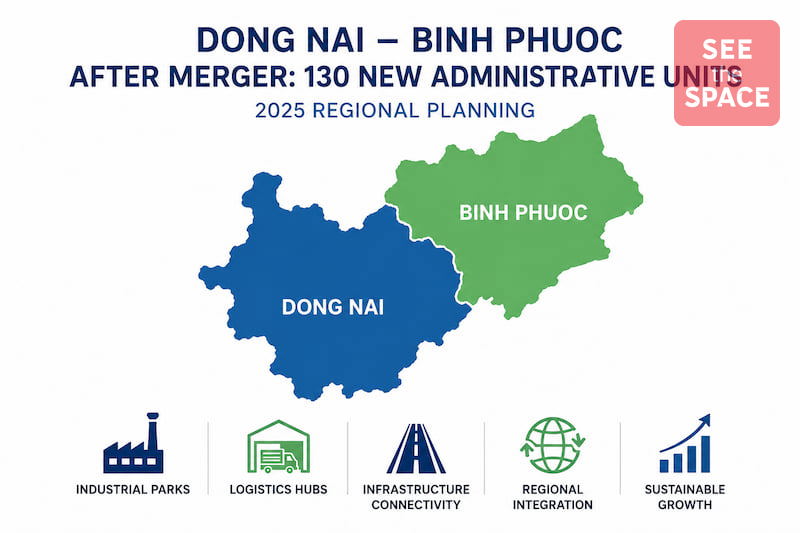
DONG NAI – BINH PHUOC REGIONAL STRUCTURE
Administrative Reorganization from an Industrial & Logistics Perspective
01. DONG NAI AFTER ADMINISTRATIVE RESTRUCTURING
New Structure: Approximately 95 Administrative Units (Wards & Communes)
1.1 Core Industrial & Logistics Zone
Nhon Trach – Long Thanh – Trang Bom – Dau Giay
Characteristics
- Highest concentration of industrial parks in the province
- Strategic connection to Long Thanh International Airport, expressways, and seaports
Role
- Primary manufacturing and logistics center for the Greater Ho Chi Minh City region
Administrative Structure
- Approximately 30 newly organized wards
1.2 Central Industrial & Urban Expansion Zone
Thong Nhat – Cam My – Xuan Loc
Characteristics
- Medium-to-large-scale industrial developments
- Available land inventory and competitive operating costs
Role
- Manufacturing satellite zone supporting Long Thanh and Trang Bom
Administrative Structure
- Approximately 25 newly organized wards
1.3 Northern & Eastern Supporting Industry Zone
Dinh Quan – Tan Phu – Vinh Cuu
Characteristics
- Light industry, processing industries, and high-tech agriculture
Role
- Supporting production and long-term industrial development
Administrative Structure
- Approximately 20 newly organized wards
1.4 Existing Urban & Industrial Center
Bien Hoa and Surrounding Areas
Characteristics
- Established urban, service, and industrial ecosystem
Role
- Workforce, residential, and industrial services hub
Administrative Structure
- Approximately 20 newly organized wards
TOTAL FOR DONG NAI: Approximately 95 New Administrative Units
02. BINH PHUOC AFTER ADMINISTRATIVE RESTRUCTURING
New Structure: Approximately 40 Administrative Units
2.1 Existing Urban & Industrial Centers
Dong Xoai – Chon Thanh – Binh Long – Phuoc Long
Role
- Administrative, urban, and existing industrial centers
Administrative Structure
- 8 wards
2.2 Southern Industrial & Logistics Growth Corridor
Hon Quan – Dong Phu – Phu Rieng
Role
- Industrial expansion, warehousing, and logistics development
- Strategic connection to Binh Duong and Dong Nai
Administrative Structure
- 12 communes
2.3 Border Trade & Cross-Border Logistics Zone
Loc Ninh – Bu Dop
Role
- Border logistics, supporting industries, and international trade
Administrative Structure
- 9 communes
2.4 Supporting Industry & Agri-Tech Development Zone
Bu Dang and Surrounding Areas
Role
- Processing industries, light manufacturing, and long-term industrial land reserve
Administrative Structure
- 9 communes
2.5 Special Ecological & Border Region
Bu Gia Map – Dak O
Administrative Status
- Existing administrative structure maintained
Administrative Structure
- 2 communes
WHAT DOES THIS MEAN FOR INDUSTRIAL TENANTS?
As administrative boundaries and local government structures evolve, companies operating within industrial parks should take proactive measures to ensure compliance and operational continuity.
Recommended Actions
✅ Review legal addresses associated with leased industrial facilities
✅ Update lease agreements and investment documentation where required
✅ Standardize addresses for business registration, customs, and tax purposes
✅ Evaluate industrial park selection based on:
- Updated administrative zoning
- Regional logistics corridors
- Long-term supply chain optimization
How SEE the SPACE Can Help
SEE the SPACE supports manufacturers, logistics operators, and investors by providing:
- Accurate administrative boundary verification
- Industrial park and warehouse site selection advisory
- Logistics and supply chain location analysis
- Lease negotiation support
- Expansion, relocation, and renewal advisory services
As Southern Vietnam's industrial landscape continues to evolve, strategic location decisions have never been more important.
Right Space. Right Budget.
SEE the SPACE – Your Industrial & Logistics Real Estate Partner in a Transforming Market.