Northern Industrial Land
Right facility. Right zone.
Northern Industrial Land
We apply the model from July 2025, enabling businesses to identify industrial parks more efficiently.






Frequently Asked Questions (FAQs)
Northern Vietnam industrial zones host a diverse range of industries, with electronics and high-tech manufacturing being the most dominant. Major sectors include consumer electronics, semiconductors, automotive parts, mechanical engineering, textile and garment production, food processing, and logistics services. Companies like Samsung, Canon, LG, and Foxconn have established large-scale production facilities in this region, making it a key hub for global electronics supply chains.
Land rental prices in Northern Vietnam's industrial zones vary depending on location, infrastructure quality, and available utilities. Generally, prices range from USD 80 to USD 180 per square meter for a lease term of 40–50 years. Industrial zones located closer to Hanoi or major transportation hubs tend to command higher prices, while those in more remote provinces offer more competitive rates. Additional costs such as management fees, infrastructure charges, and security deposits should also be factored into the total investment budget.
Foreign investors in Northern Vietnam's industrial zones can benefit from a range of tax incentives. Projects in high-tech sectors or underdeveloped areas may enjoy a preferential corporate income tax (CIT) rate of 10% for the entire project duration, compared to the standard 20%. Additionally, investors may receive a tax exemption for the first 4 years of profitable operation, followed by a 50% tax reduction for the subsequent 9 years. Import duty exemptions on raw materials, components, and machinery for production purposes are also commonly available.
Northern Vietnam offers one of the most abundant and skilled labor pools in the country. The region is home to numerous universities, technical colleges, and vocational training centers that produce hundreds of thousands of qualified graduates annually. The workforce is known for its strong work ethic, adaptability, and increasing proficiency in technical skills. Labor costs in Northern Vietnam remain competitive compared to other manufacturing destinations in Asia, though wages have been gradually increasing in line with economic development.
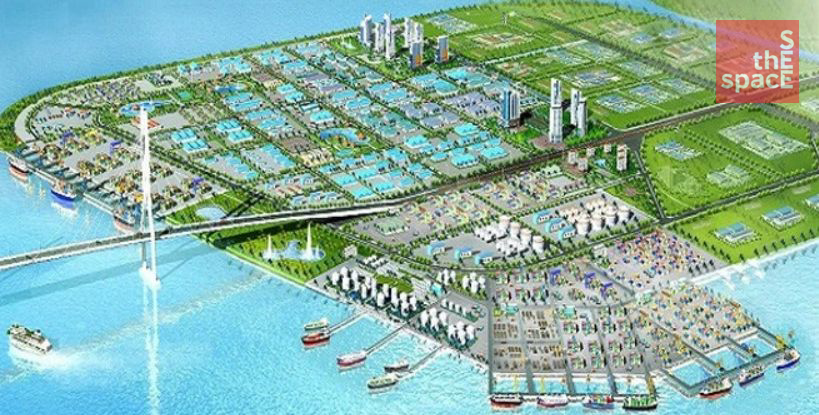
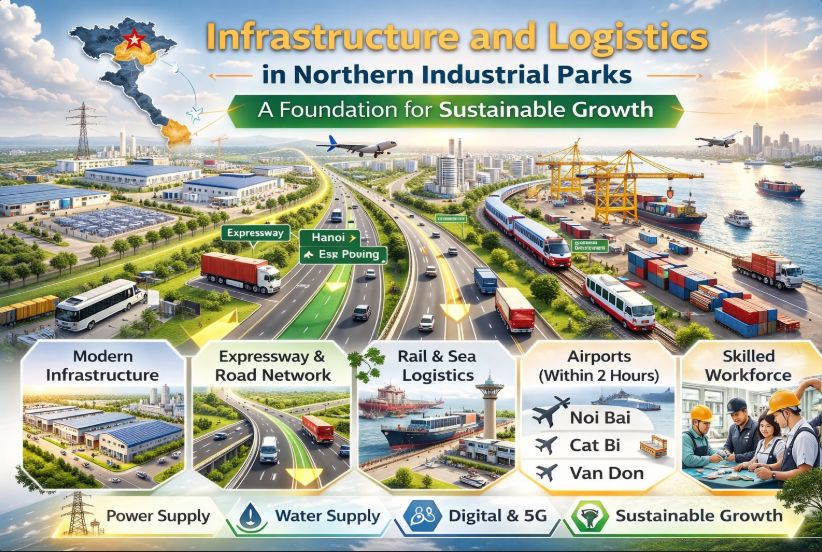
Northern Vietnam's industrial zones benefit from a well-developed infrastructure network. Key logistics assets include Hai Phong Port – the largest seaport in the North with deep-water terminals at Lach Huyen – and Noi Bai International Airport in Hanoi, which handles significant cargo volumes. The region is connected by a growing network of expressways linking industrial zones to ports, airports, and border gates with China. Within industrial zones, tenants have access to reliable electricity supply, clean water, wastewater treatment systems, high-speed fiber optic internet, and 5G connectivity.
Contact us via:
📞 Hotline: 0768 999 647 l 📧 Email: leasing@seethespace.vn
We will provide full documents within 24 hours.
Northern Vietnam has long asserted its leading role in national industrial development. With a system of industrial parks stretching from Hanoi, Hung Yen, Bac Ninh, Hai Duong to Quang Ninh and Hai Phong, this economic region attracts billions of USD in foreign investment annually. Synchronized transportation infrastructure and an abundant, highly skilled workforce are significant competitive advantages.
According to data from the Ministry of Planning and Investment, the average occupancy rate in Northern industrial parks is over 75%, with many parks in Bac Ninh and Hung Yen reaching 90-100%. Major technology corporations such as Samsung, Canon, LG, and Foxconn have all chosen Northern Vietnam as their strategic production base. This demonstrates the strong appeal of the industrial ecosystem here.
Besides the geographical advantage – close to the northern border gate and Hai Phong seaport – industrial parks in the North also benefit from many attractive preferential policies regarding corporate income tax, land lease fee exemptions and reductions, and investment procedure support. The business environment is constantly improving, administrative procedures are streamlined, creating favorable conditions for businesses to quickly implement projects.
The industrial park system in the North is also undergoing a strong transformation towards green and sustainable development. Many industrial parks have adopted strict environmental standards, built centralized wastewater treatment systems, used renewable energy, and implemented eco-industrial park models in line with the Government's direction. This is an inevitable trend to meet the requirements of foreign investors with high ESG (environmental, social, and governance) standards.
With the industrial park development plan until 2030 and a vision for 2045, the North will continue to expand and upgrade industrial infrastructure, attracting more high-tech industries such as semiconductors, electronics, information technology, and smart manufacturing. This is a golden opportunity for investors who want to enter the Vietnamese industrial market
SEE THE SPACE provides industrial site selection advisory and leasing support across Northern Vietnam — completely free of charge for tenants.
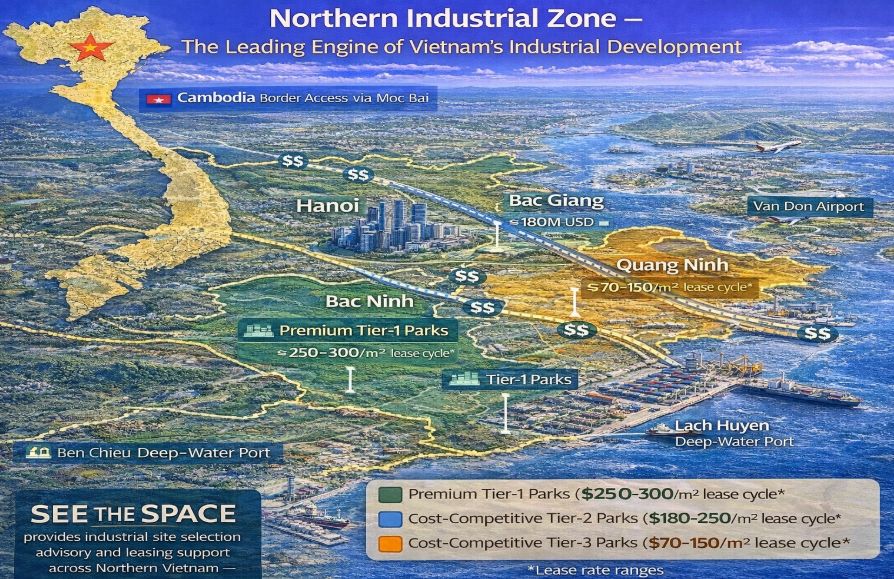
Hanoi and surrounding provinces such as Bac Ninh, Hung Yen, Ha Nam, and Vinh Phuc are forming an integrated industrial zone with significant scale and development potential. This area concentrates many of the largest and most modern industrial parks in the country, playing a crucial role in the global supply chain.
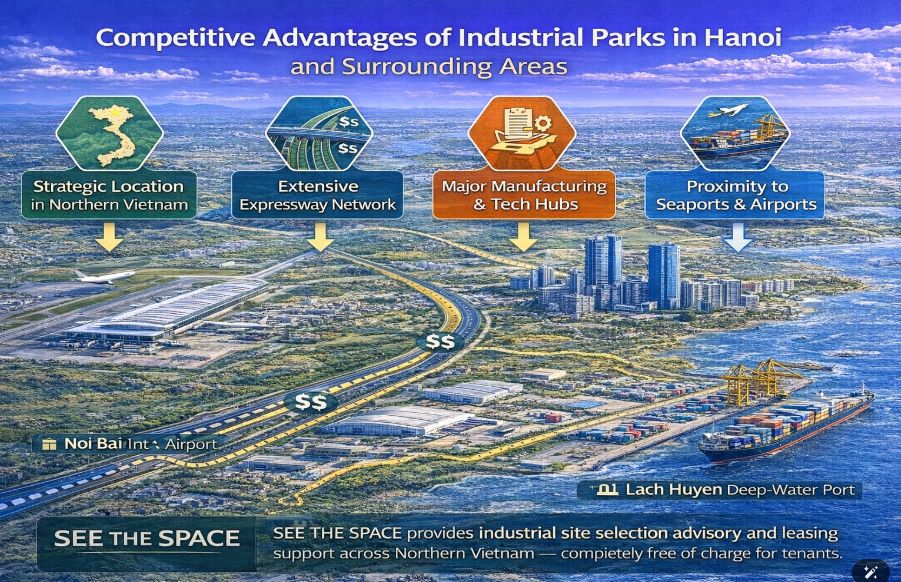
The first advantage is its complete transportation infrastructure. The highway system connecting Hanoi with neighboring provinces, such as the Hanoi-Hai Phong, Noi Bai-Lao Cai, and Hanoi-Thai Nguyen expressways, facilitates fast and cost-effective goods transportation. Noi Bai International Airport, with its large cargo handling capacity, is also a key factor attracting export businesses.
A high-quality workforce is the second strength of this region. Hanoi is the largest training center in the country, with hundreds of universities, colleges, and vocational training centers. Each year, this region provides hundreds of thousands of skilled workers for its industrial parks. Furthermore, labor costs in Northern Vietnam are more competitive compared to many countries in the region such as China, Thailand, and Malaysia.
Regarding the investment environment, provinces like Bac Ninh and Hung Yen consistently rank highly in the Provincial Competitiveness Index (PCI). Local authorities proactively support investors, from licensing to project implementation, with a "red carpet" approach to welcoming FDI enterprises. Administrative procedures have been simplified, and many provinces have implemented one-stop electronic portals to help businesses save time and costs.
The industrial park planning space in this region is still wide open with many clean land plots ready for lease. Industrial park land lease prices in Hanoi's satellite provinces are currently competitive, ranging from 80–150 USD/m² depending on location and infrastructure. With the current development rate, this is considered an ideal time for businesses to establish themselves in this promising market.
SEE THE SPACE provides industrial site selection advisory and leasing support across Northern Vietnam — completely free of charge for tenants.
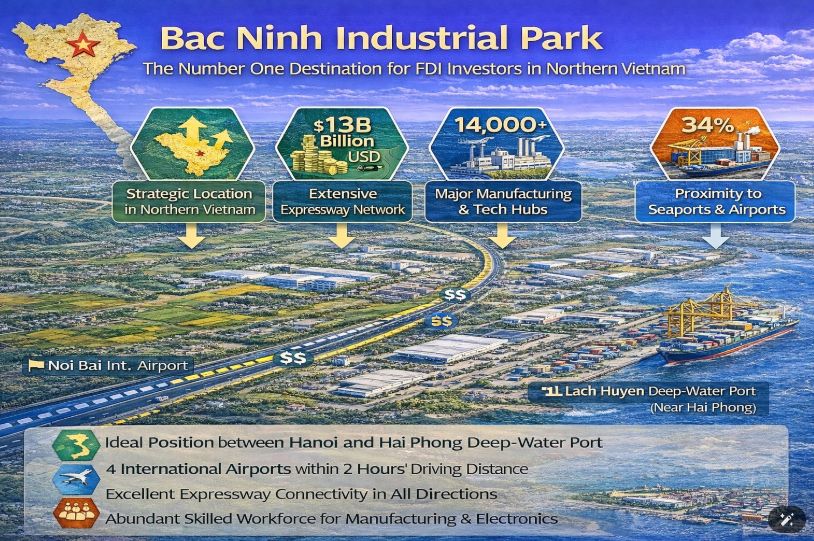
Bac Ninh – the smallest province in Vietnam by area – is one of the most attractive investment destinations in the North. Strategically located just 30km from the center of Hanoi and adjacent to major transportation routes, Bac Ninh has become the "electronics capital" of Vietnam, home to large-scale production facilities of Samsung, Canon, and Panasonic.
Currently, Bac Ninh has over 15 planned and developed industrial parks covering thousands of hectares. Large industrial parks such as Tien Son, Que Vo, VSIP Bac Ninh, and Yen Phong have all achieved high occupancy rates, demonstrating the province's strong appeal. The infrastructure in Bac Ninh's industrial parks is considered among the most modern and integrated in the North, fully meeting the needs of both small and medium-sized enterprises as well as multinational corporations.
A highlight of Bac Ninh's industrial parks is its diverse and closely interconnected industrial ecosystem. The presence of large corporations has attracted hundreds of satellite businesses, component suppliers, and production support service providers. This creates a closed supply chain, helping to reduce production costs and increase operational efficiency for all businesses in the region.
The Bac Ninh provincial government has a clear and consistent investment attraction strategy. The province prioritizes high-tech projects with high added value and environmental friendliness. Tax incentives, land lease fees, and project implementation support are applied flexibly according to each sector and investment scale. In particular, Bac Ninh is promoting the development of industrial parks based on ecological models, aiming to become a smart and sustainable industrial province.
Looking to the future, Bac Ninh is aiming to attract next-generation industries such as semiconductor chip manufacturing, high-tech medical equipment, and fields related to the Fourth Industrial Revolution. With a solid industrial foundation and a favorable investment environment, Bac Ninh promises to continue being a top destination for foreign investors in the coming years.
SEE THE SPACE provides industrial site selection advisory and leasing support across Northern Vietnam — completely free of charge for tenants.
One of the key factors determining the success of industrial parks is their supporting infrastructure and logistics system. In Northern Vietnam, strong investment in infrastructure in recent years has created a solid foundation for the production and export activities of businesses.
The highway system is being rapidly completed, connecting industrial parks with seaports, airports, and international border crossings. Hai Phong Port – the largest container port in the North – is being expanded and upgraded with a deep-water berth at Lach Huyen, capable of receiving large container ships. This significantly reduces the cost and time of transporting export goods.
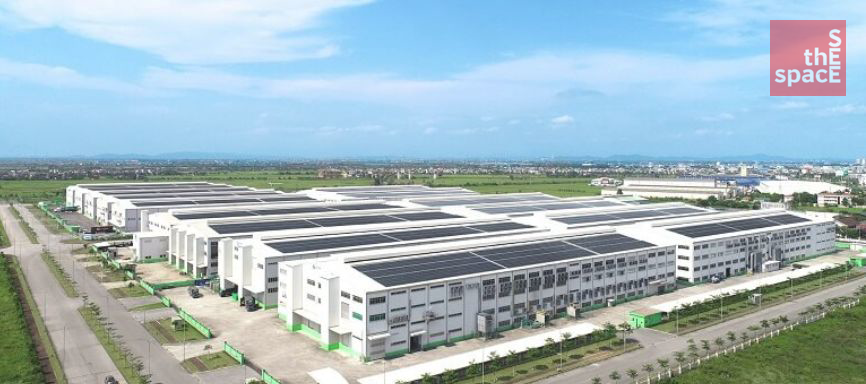
The electricity and water infrastructure in industrial parks in the North has been systematically invested in. Most large industrial parks have their own substations, ensuring a stable power supply for production 24/7. Centralized water supply, drainage, and wastewater treatment systems have also been built synchronously, meeting increasingly stringent environmental standards. Many industrial parks have invested in rooftop solar power systems, contributing to reducing electricity costs for tenant businesses.
Logistics services in and around industrial parks in Northern Vietnam are increasingly diverse. Smart warehouses, distribution centers, and domestic and international transportation services are all present, supporting businesses in optimizing their supply chains. The development of cross-border e-commerce also boosts the demand for warehousing and logistics in this area.
Regarding telecommunications and digital connectivity, industrial parks in Northern Vietnam are covered by 5G and have high-speed fiber optic cable systems, meeting the needs of businesses in the digital age. Many industrial parks are deploying smart management platforms, applying IoT and AI to optimize infrastructure operations, improve management efficiency, and enhance the business experience.
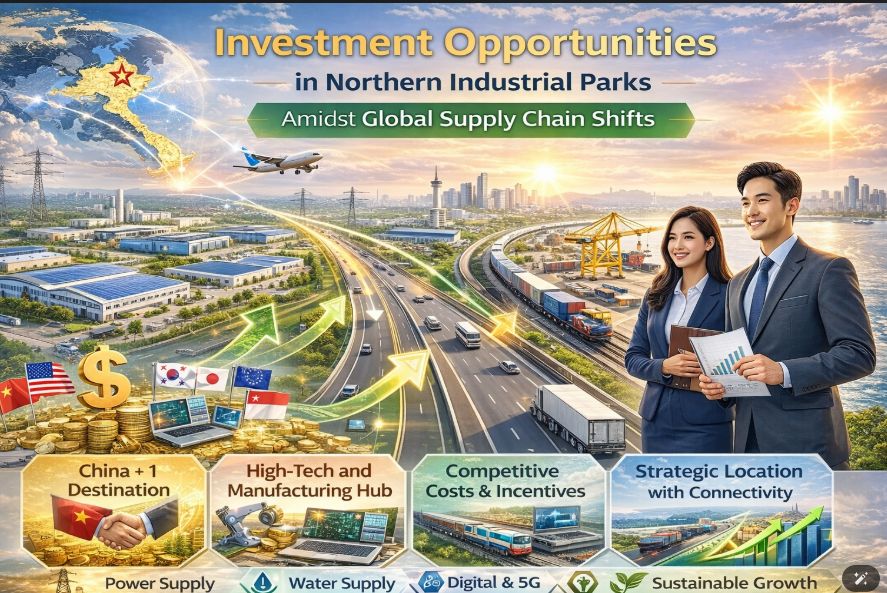
The global supply chain shift is creating exceptional opportunities for industrial parks in Northern Vietnam. The US-China trade tensions, coupled with the "China Plus One" strategy of many multinational corporations, have fueled a wave of manufacturing relocation to Vietnam, with the North being a preferred destination.
Large corporations from the US, Japan, South Korea, and Europe are actively seeking factory locations in Northern Vietnam. The most sought-after sectors include electronics, semiconductors, medical equipment, electric vehicles, and high-tech consumer goods. These are precisely the areas that Northern industrial parks are focusing on, creating an ideal fit between supply and demand.
The Vietnamese government is implementing strong support policies to welcome this investment wave. The resolution on attracting a new generation of FDI prioritizes high-tech projects with significant spillover effects and connections to domestic businesses. Special tax incentives for investment projects in the semiconductor, artificial intelligence, and green technology sectors are being studied for implementation.
Vietnam is also actively improving its legal system related to investment, intellectual property, labor, and the environment towards transparency and compliance with international standards. Participation in numerous free trade agreements (FTAs) such as EVFTA, CPTPP, and RCEP provides significant export advantages for manufacturing businesses in Vietnam.
Many experts consider the current time a "golden window of opportunity" for investing in industrial parks in Northern Vietnam. Land in strategic industrial parks is being filled rapidly, land and labor costs remain competitive, and the domestic market with nearly 100 million people is experiencing strong growth. This is the time for businesses to act to avoid missing out on opportunities.
SEE THE SPACE provides industrial site selection advisory and leasing support across Northern Vietnam — completely free of charge for tenants.