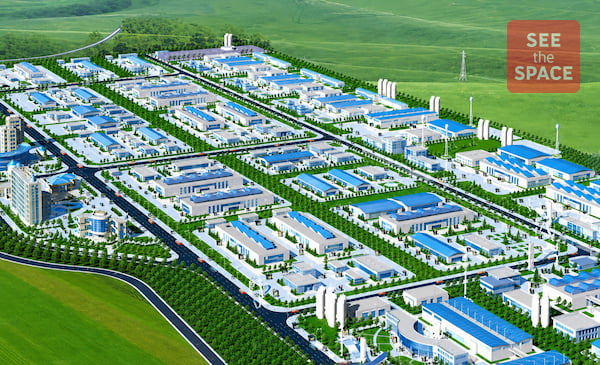
Industrial Land in Dong Nai

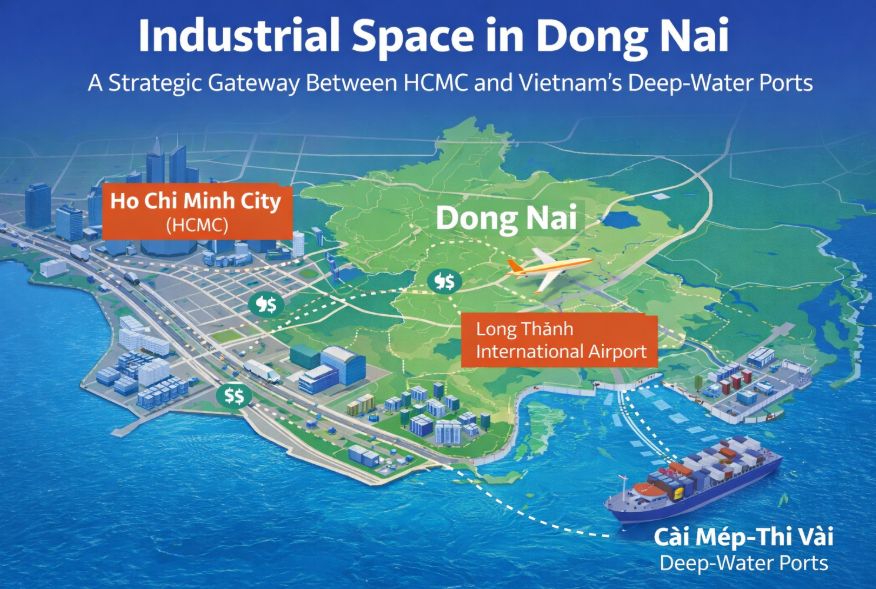
Dong Nai, including Binh Phuoc, is a major industrial hub and a key satellite of Ho Chi Minh City, well-suited for large-scale manufacturing, supporting industries, and logistics operations. With extensive industrial land, a well-established industrial ecosystem, and strong connectivity to Ho Chi Minh City, seaports, and the upcoming Long Thanh International Airport, industrial parks in Dong Nai support long-term and scalable growth. 

With SEE THE SPACE Industrial , businesses receive free consultation to identify industrial solutions aligned with operational needs and budget efficiency.

Frequently Asked Questions (FAQs)

Dong Nai combines proven FDI credentials — with over USD 1 billion in annual investment and anchor investors including Hyosung, Bosch, and Nestlé — with a wide choice of industrial parks (31+), competitive pricing versus HCMC, and excellent logistics connectivity to both HCMC and Cai Mep–Thi Vai deep-water port. The upcoming Long Thanh International Airport within the province adds a future air freight gateway that further strengthens its logistics credentials. This combination of track record, choice, and connectivity makes Dong Nai one of Vietnam's most compelling industrial locations

Dong Nai's industrial land lease rates range from USD 100–220/m²/lease cycle. Premium parks like Amata Long Thanh sit at the upper end; developing parks with larger remaining land banks (Giang Dien, Nhon Trach VI) offer more competitive entry pricing. All rates are exclusive of VAT (10%) and management fees. 

The province's new Binh Phuoc areas (post-merger) offer additional options from USD 60–100/m²/cycle.

Long Thanh International Airport —targeted for partial opening in 2026 — will provide direct air freight access to global markets from within the province. For industrial tenants, this means significantly reduced logistics time and cost for high-value, time-sensitive exports (electronics, precision components, pharmaceuticals) that currently require routing via Tan Son Nhat Airport in HCMC. Industrial parks in Long Thanh and Nhon Trach districts are best positioned to benefit from this airport-driven logistics upgrade.

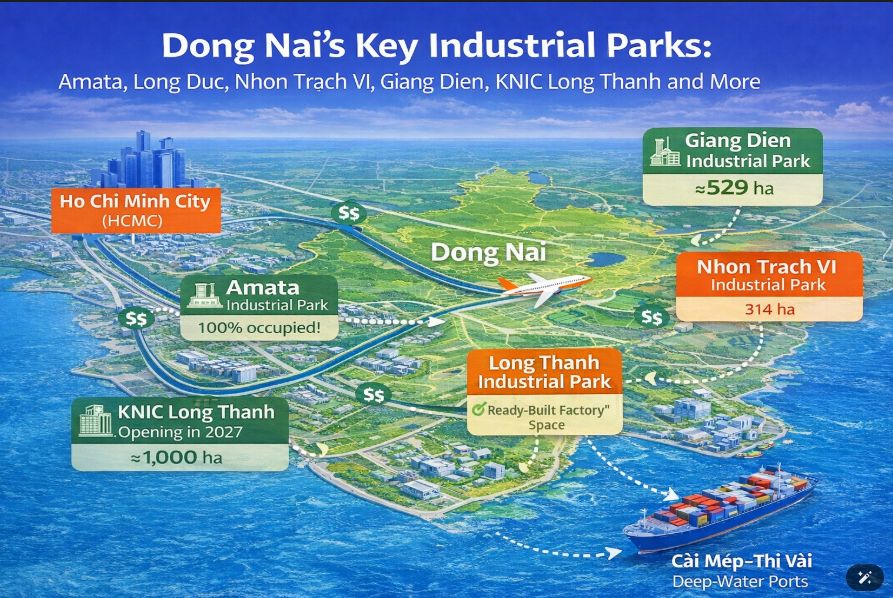
Giang Dien Industrial Park (529 ha, approximately 40–50% occupancy) and Nhon Trach VI Industrial Park (314 ha, approximately 66% occupancy) currently offer Dong Nai’s largest remaining land banks, making them well suited for large-scale manufacturing projects requiring substantial site areas.

Long Duc Industrial Park (281 ha, Long Thanh district) also has meaningful remaining availability, combining solid infrastructure quality with more competitive pricing than premium benchmark parks.

Amata Long Thanh Industrial Park has limited remaining availability due to its premium positioning and strong FDI demand, so early engagement is essential for tenants targeting this park.

Looking ahead, KNIC Long Thanh Industrial Park — a new 1,000-hectare development scheduled to commence operations in 2027 — will represent Dong Nai’s largest future source of industrial land, particularly attractive for large, long-term investments aligned with Long Thanh International Airport.
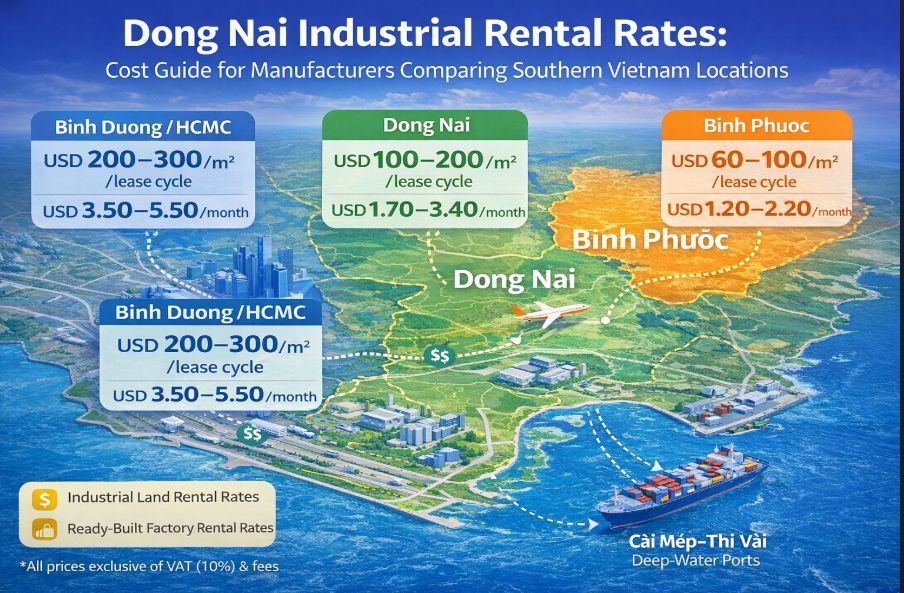


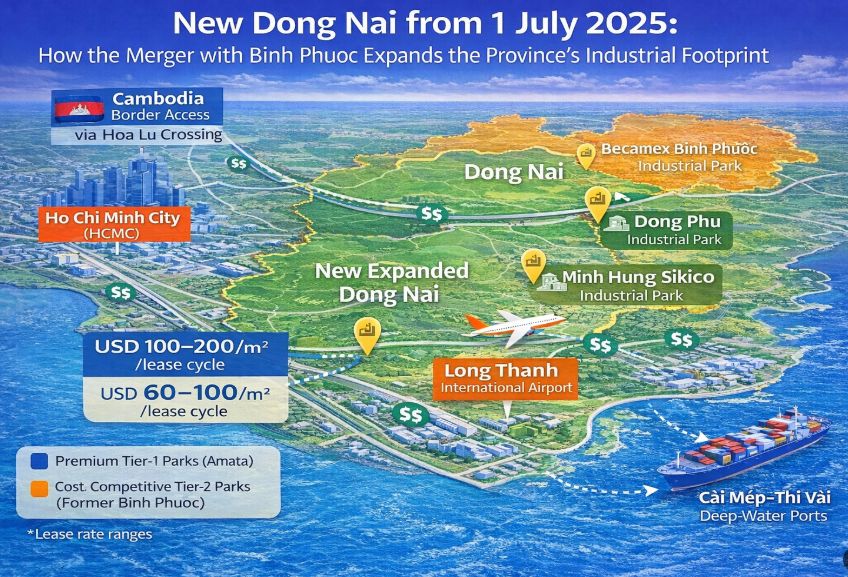
The merger incorporates Binh Phuoc into Dong Nai, adding industrial parks (Becamex Binh Phuoc, Dong Phu, Minh Hung Sikico) with competitive land pricing of USD 60–100/m²/cycle — significantly below former Dong Nai levels — and cross-border access to Cambodia via the Hoa Lu border crossing. The expanded province now offers industrial options across a broader cost and location spectrum, from premium Tier-1 parks (Amata, USD 100–220/m²) to cost-competitive Tier-2 alternatives (former Binh Phuoc, USD 60–100/m²) within a single provincial framework.

"Dong Nai is one of Vietnam's three largest industrial provinces and a cornerstone of the Southern Key Economic Region — offering businesses premium industrial park options, proven FDI credentials, and direct connectivity to both Ho Chi Minh City and the Cai Mep–Thi Vai deep-water port cluster.

The province's strategic position — sitting directly between HCMC and Ba Ria–Vung Tau — makes it a natural industrial hub for businesses that need access to both Vietnam's largest domestic market and its premier international deep-water shipping gateway. Dong Nai has attracted consistent FDI flows exceeding USD 1 billion annually, with anchor investors including Hyosung, Formosa, Bosch, Lixil, and Nestlé validating the province's quality credentials across sectors ranging from textiles and materials to food processing and precision manufacturing.

The province hosts 31+ industrial parks covering over 10,000 hectares and attracts USD 1+ billion in FDI annually, with investors such as Hyosung, Bosch, Lixil, and Nestlé. Options range from internationally managed parks like Amata Long Thanh to large-scale developments such as Giang Dien, serving a wide spectrum of costs and specifications. Looking ahead, Dong Nai’s competitiveness will be further strengthened by Long Thanh International Airport and the KNIC Long Thanh Industrial Park (approximately 1,000 ha, targeted for completion in 2027), positioning the province as a key hub for high-tech manufacturing and aviation-linked logistics.

A defining future advantage is the ongoing development of Long Thanh International Airport — one of Southeast Asia's most significant infrastructure projects — located within Dong Nai's borders. Once operational, it will provide direct air freight access to global markets and is expected to drive significant additional industrial and logistics demand in the province's eastern districts.

For businesses evaluating Dong Nai, SEE THE SPACE provides market data, site inspections, and full lease negotiation support — completely free of charge."

See The Space

Dong Nai offers a compelling price-to-quality proposition in Southern Vietnam — industrial land and ready-built factory rates that are materially below HCMC, while delivering comparable logistics access and, in premium parks, comparable infrastructure quality. 

Industrial land lease rates in Dong Nai range from USD 100–220/m²/lease cycle. Premium internationally managed parks — such as Amata Long Thanh — sit at the upper end of this range, reflecting the higher infrastructure quality and stronger management standards. Developing parks with significant remaining land banks — such as Giang Dien (approximately 40–50% occupancy) and Nhon Trach VI (approximately 66% occupancy) — offer more competitive entry pricing, with larger available lots that suit businesses seeking scale. All land lease rates are exclusive of VAT (10%) and infrastructure management fees. 

Businesses comparing Dong Nai against HCMC should factor in the full cost equation: while land and factory rates are lower, logistics costs to Cat Lai Port are slightly higher (45–60 minutes versus 20–40 minutes from HCMC's eastern zones). Access to the Cai Mep–Thi Vai deep-water port via NH51 is, however, comparably convenient — making Dong Nai particularly attractive for businesses shipping on direct deep-water services to Europe and the US West Coast. 

SEE THE SPACE provides free cost benchmarking and lease advisory for all industrial enquiries across Dong Nai's 31+ industrial parks. vnese

See The Space

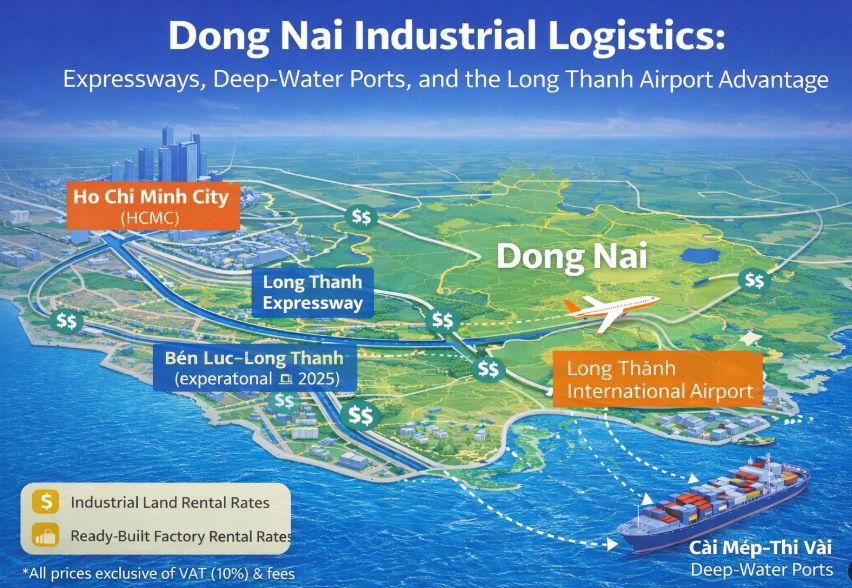
"Dong Nai's logistics infrastructure is among the strongest of any industrial province in Southern Vietnam — combining expressway access to HCMC, direct highway connectivity to Cai Mep–Thi Vai deep-water port, and the transformative future advantage of Long Thanh International Airport located within the province.

The HCMC–Long Thanh–Dau Giay Expressway is Dong Nai's primary logistics artery. It provides direct, high-speed road freight access to HCMC in approximately 30–60 minutes from well-located industrial zones — enabling Dong Nai-based manufacturers to tap HCMC's supplier ecosystem, domestic distribution network, and Cat Lai Port with minimal additional logistics cost compared to HCMC-based operations. The expressway also connects northward toward the Central Highlands and national north–south corridor, providing reach for businesses sourcing raw materials from northern provinces.

National Highway 51 connects Dong Nai's industrial zones directly to Ba Ria–Vung Tau and the Cai Mep–Thi Vai deep-water port cluster — typically within 60–90 minutes from most parks. Cai Mep–Thi Vai is Vietnam's only port capable of handling ultra-large container vessels on direct sailings to the US West Coast, Europe, and Northeast Asia, making it the preferred port for high-volume export manufacturers. For Dong Nai-based businesses, NH51 access to this world-class port is a significant logistics advantage that is often undervalued in initial location comparisons.

Long Thanh International Airport — under active construction within Dong Nai, targeted for partial opening in 2026 — will be transformative for the province's logistics credentials. Once operational, it will provide direct air freight access to global markets from within the province, reducing the need to route high-value cargo through Tan Son Nhat Airport. Industrial zones in Long Thanh and Nhon Trach districts are particularly well-positioned to benefit from airport-driven logistics demand.

SEE THE SPACE provides logistics analysis and free site shortlisting across all Dong Nai industrial zones — zero fees to tenants."

See The Space

Dong Nai’s 31+ operational industrial parks span a wide range of infrastructure quality, management standards, and pricing — making park selection a critical decision for companies entering the province. Key parks differ significantly in land availability, tenant mix, connectivity, and lease flexibility.

Amata Long Thanh Industrial Park is Dong Nai’s premium benchmark park. Developed by Amata Corporation, it attracts a high concentration of Japanese and Korean manufacturing FDI and offers international-grade infrastructure, professional management, and strong environmental compliance. Land prices sit at the upper end of the market, and remaining availability is limited, making early engagement essential.

Long Duc Industrial Park (281 ha) delivers high infrastructure standards at more competitive pricing, with meaningful land still available. Located within the Long Thanh airport catchment, it is particularly attractive for logistics-driven and air-freight-related manufacturing.

For companies requiring large land plots, Nhon Trach VI Industrial Park (314 ha, ~66% occupancy) and Giang Dien Industrial Park (529 ha, ~40–50% occupancy) offer Dong Nai’s largest remaining land banks, with competitive entry pricing and solid expressway and port connectivity.

Looking ahead, KNIC Long Thanh is a next-generation industrial megaproject of approximately 1,000 hectares, targeted to commence operations around 2027. Positioned near Long Thanh International Airport, KNIC is expected to become a strategic hub for high-tech manufacturing, logistics, and future-oriented industries.

SEE THE SPACE provides independent industrial park comparisons, logistics analysis, and free site inspections across all Dong Nai industrial zones — with zero fees to tenants.

See The Space

"Effective 1 July 2025, Dong Nai province expanded significantly through its administrative merger with Binh Phuoc — creating a larger province that combines Dong Nai's world-class Tier-1 industrial parks and Long Thanh Airport infrastructure with Binh Phuoc's cost-competitive industrial land bank, significant remaining availability, and cross-border access to Cambodia.

Binh Phuoc was formerly one of Southern Vietnam's most underappreciated industrial provinces — offering competitive land lease rates of USD 60–100/m²/cycle, significant remaining availability at parks including Becamex Binh Phuoc Industrial City, Dong Phu Industrial Park, and Minh Hung Sikico, and direct road access to Binh Duong (now part of Greater HCMC) via National Highway 13. The merger brings all of this within the same administrative jurisdiction as Dong Nai's premium parks — giving businesses a single provincial framework covering industrial options from USD 60/m²/cycle (former Binh Phuoc) to USD 200/m²/cycle (Amata Long Thanh).

For businesses already operating within former Dong Nai, the merger adds strategic optionality: expansion into former Binh Phuoc areas is now within the same provincial framework, simplifying licensing, permitting, and investment incentive structures. Former Binh Phuoc's Hoa Lu border crossing with Cambodia also adds a cross-border trade dimension to the merged province's logistics capabilities — complementing Dong Nai's existing expressway and deep-water port access.

For new entrants evaluating the merged province, the key consideration is cost-versus-logistics trade-off: former Binh Phuoc zones offer lower land costs but slightly longer logistics runs to Cai Mep–Thi Vai and HCMC compared to former Dong Nai zones. National Highway 13's connection to Binh Duong and the expressway network helps mitigate this, but businesses with stringent port-proximity requirements should factor transit times carefully.

SEE THE SPACE provides post-merger advisory across the full new Dong Nai province — both former Dong Nai and former Binh Phuoc zones — at zero cost to tenants."

See The Space