Industrial Land in HCMC
Right facility. Right zone.
Industrial Land in HCMC
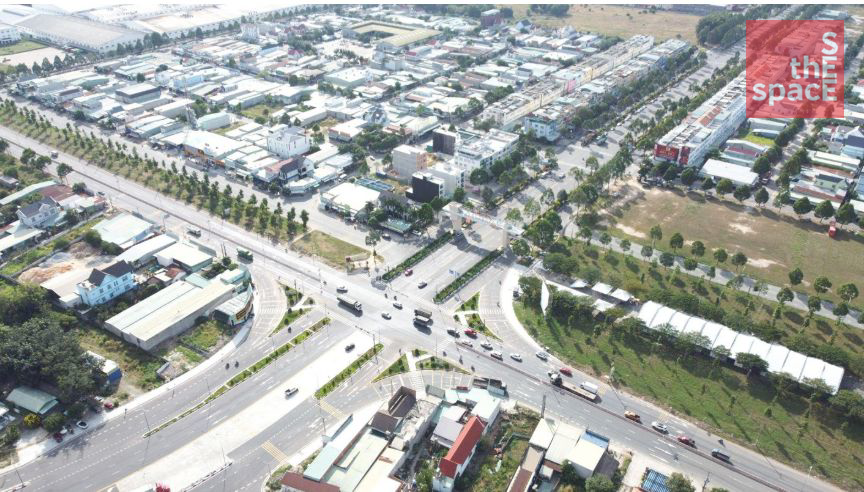
Ho Chi Minh City (including Binh Duong & Ba Ria – Vung Tau) is Southern Vietnam's largest hub for manufacturing, logistics and distribution — with integrated infrastructure, abundant workforce and direct access to seaports and airports.






Frequently Asked Questions (FAQs)
HCMC combines Vietnam’s highest concentration of export manufacturers, the country’s busiest container port (Cat Lai), and a well-established industrial regulatory framework (HEPZA). Together with a 9-million-strong workforce and proximity to the largest consumer market, the city remains a Tier-1 destination for both FDI and domestic industrial investment.
Industrial land lease rates in HCMC range from USD 180–300/m²/lease cycle depending on zone and location — the highest in Vietnam. Occupancy remains above 90% across the city's portfolio, reflecting persistent strong demand. All headline rates are exclusive of VAT (10%) and management fees, which typically add 10–15%. Businesses should engage an advisor early, as available lots and units are leased quickly.
HCMC has Vietnam’s most complete industrial logistics network, anchored by Cat Lai Port — the country’s busiest container terminal — reachable within 20–60 minutes from most industrial zones. Tan Son Nhat International Airport supports air freight, while ring roads and expressways link the city to all key Southern provinces. Long Thanh International Airport will further expand air cargo capacity within 30–45 minutes of eastern HCMC.
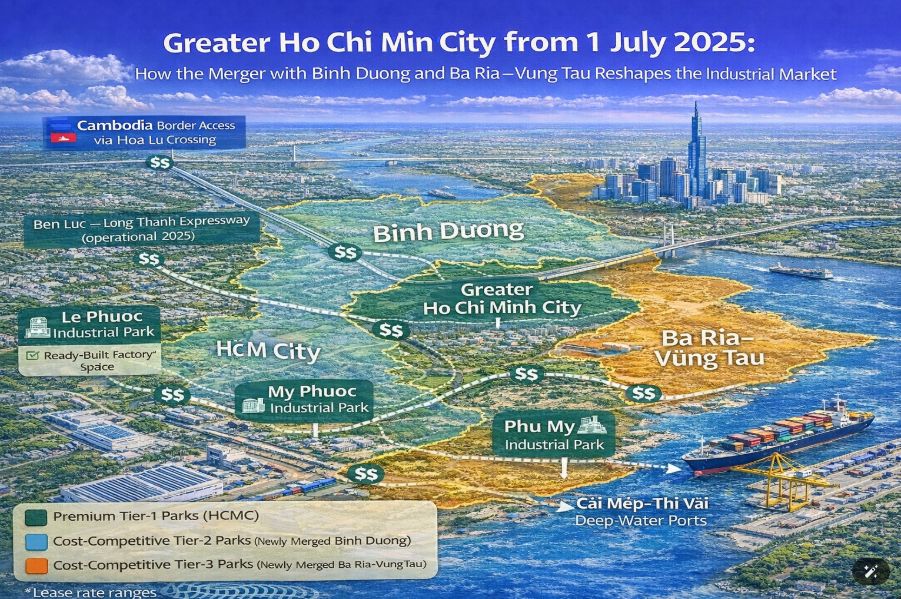
The merger forms Greater HCMC, unifying HCMC, Binh Duong, and Ba Ria–Vung Tau under one administration. Industrial tenants gain access to a wider range of zones—from VSIP in Binh Duong to port-adjacent Phu My—within a single regulatory framework, with Cai Mep–Thi Vai deep-water port now included. Industrial land prices across the merged region range from USD 100–300/m²/cycle.

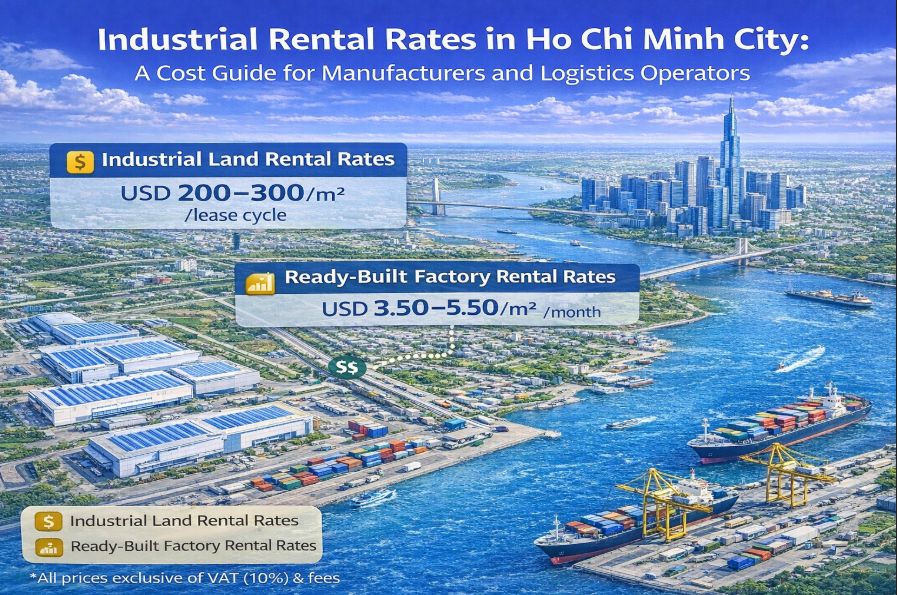
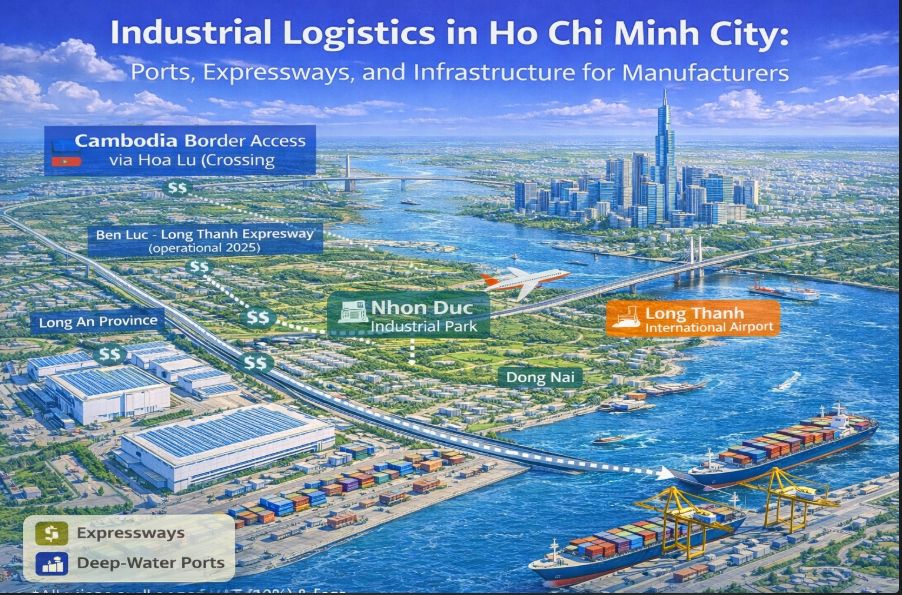
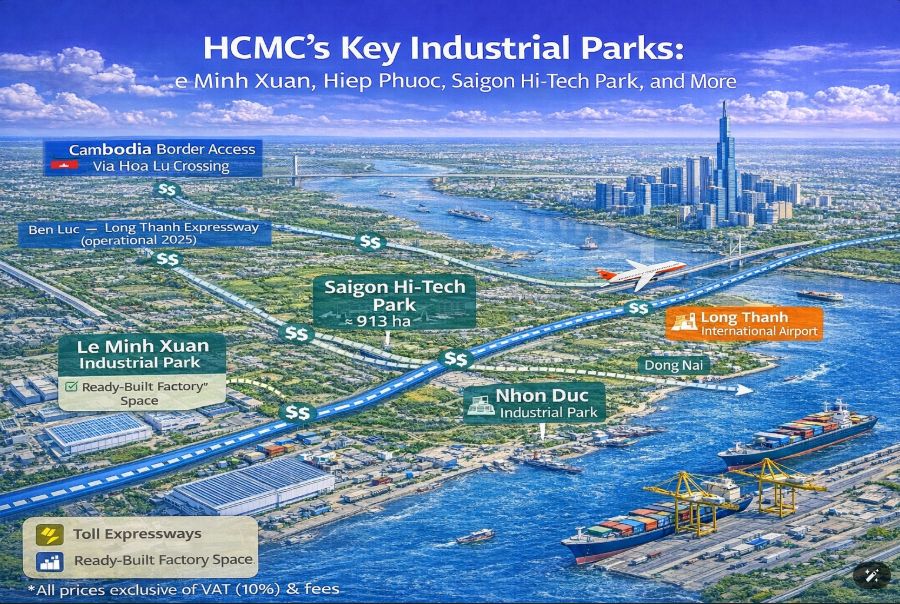
Ho Chi Minh City hosts a diverse portfolio of industrial parks and export processing zones, each with distinct tenant profiles, infrastructure standards, and strategic positioning. Selecting the right zone requires careful consideration of sector fit, logistics needs, and budget parameters.
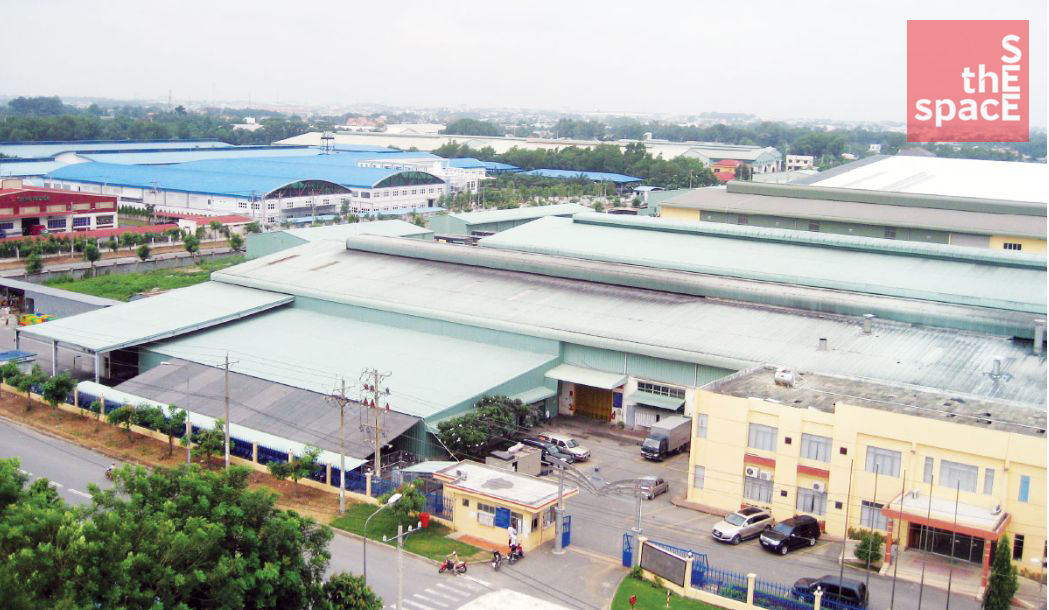
Le Minh Xuan Industrial Park (Binh Chanh District) is one of the earliest-developed industrial parks in western HCMC. It accommodates a wide range of manufacturers in food processing, packaging, plastics, light engineering, and consumer goods. Key advantages include relatively stable land availability, more competitive rental levels compared with core-city zones, and strong connectivity to National Highway 1A, the HCMC–Trung Luong Expressway, and the Mekong Delta—making it suitable for both domestic-focused and export-oriented operations.
Hiep Phuoc Industrial Park (Nha Be District) is undergoing a strategic transition toward eco-industrial and high-tech manufacturing under HEPZA’s long-term plan. Phases 1 and 2 host a mix of manufacturing tenants, while Phase 3 is being developed with higher environmental standards. Its Soai Rap River frontage enables direct inland waterway access, offering logistics advantages for bulk and semi-bulk cargo users.
Saigon Hi-Tech Park (SHTP, Thu Duc City) is HCMC’s flagship destination for technology-intensive FDI. Global manufacturers such as Samsung, Intel, and Jabil operate here. The park offers international-grade infrastructure and investment incentives for qualified high-tech and R&D-driven projects.
Tan Binh Industrial Park and Binh Chieu Industrial Park serve mid-sized manufacturers across multiple sectors, providing more cost-efficient ready-built factory options than SHTP while maintaining strong connectivity to HCMC’s port and airport infrastructure.
SEE THE SPACE provides independent zone comparison analysis and site inspections across all industrial parks in Ho Chi Minh City—free of charge for tenant clients.
"Effective 1 July 2025, Vietnam implemented one of the most significant administrative restructurings in its modern history. Ho Chi Minh City merged with Binh Duong and Ba Ria–Vung Tau to form a single unified administrative unit — creating Greater Ho Chi Minh City, now Vietnam's largest and most industrially powerful province by almost every measure.
The merger's industrial implications are profound. Binh Duong contributed Vietnam's largest concentration of VSIP and BECAMEX-managed industrial parks — including VSIP 1, 2, and 3, and Becamex Industrial City — renowned for international-grade infrastructure and strong FDI from Japan, South Korea, Singapore, and Taiwan. Ba Ria–Vung Tau added the Cai Mep–Thi Vai deep-water port cluster — one of Southeast Asia's most capable port facilities, able to handle ultra-large container vessels sailing direct to the US, Europe, and Northeast Asia. Post-merger, Greater HCMC now controls a port system of 99 seaports — more than any other province in Vietnam.
For businesses already operating within former HCMC, Binh Duong, or Ba Ria–Vung Tau, the merger streamlines cross-boundary logistics, permitting, and investment planning within a single administrative framework. For new entrants, it creates a single decision-making point for industrial location selection across a far broader range of zones, infrastructure grades, and price points — from USD 100–180/m²/cycle in port-adjacent Ba Ria–Vung Tau zones to USD 120–200 in Binh Duong and USD 180–300 in core HCMC areas.
The merger also raises strategic questions for existing investors: businesses with facilities split across former provincial boundaries should review their operating licences, tax status, and logistics arrangements to ensure alignment with the new unified administrative framework.
SEE THE SPACE provides advisory support for businesses navigating the post-merger industrial market across all territories of the new Greater HCMC — completely free of charge to tenants and occupiers."