News
- Tags: Industrial Park Market News,
- Author: Admin STS,
- Date posted: 20/02/2026
New Tây Ninh City After Long An Merger | Industrial Parks & Logistics Hub
New Tây Ninh City After the Merger with Long An: An Emerging Interregional Hub for Industrial Parks & Logistics
Following the administrative restructuring, Tây Ninh City has entered a new development phase, being repositioned within an expanded regional framework together with Long An—one of Southern Vietnam’s most important industrial and logistics centers.
This restructuring goes beyond administrative consolidation. It unlocks large-scale, well-planned industrial land, synchronized infrastructure, and stronger cross-border connectivity, laying the foundation for the next growth cycle of industrial parks (IPs) and logistics hubs.
1. New Urban & Administrative Structure of Tây Ninh City
After the merger and reorganization, Tây Ninh City is structured into 96 wards/communes, positioning it as:
- The administrative, political, and service center of the province
- A coordination hub for industrial, urban, and logistics development
- A strategic connector between Ho Chi Minh City – Long An – Tây Ninh and the Cambodia border corridor
This enlarged administrative scale enables integrated planning for industrial parks, industrial–urban townships, and modern logistics zones, overcoming the fragmentation constraints of the former small-unit model.
2. Key Advantages for Industrial Park Development
Expanded Industrial Land Bank
- From standalone IPs → integrated IP–urban–service clusters
- From cost-driven locations → value-chain-driven locations
- From satellite markets → independent growth poles
This is a critical early-entry phase for industrial investors, ahead of expected increases in land prices and occupancy rates over the medium term.
Stronger Regional Connectivity
New Tây Ninh City sits within a strategic corridor linking:
- Long An – the western industrial gateway of HCMC
- Cambodia – cross-border trade and logistics flows
As a result, industrial parks in Tây Ninh benefit from:
- Lower logistics costs
- Broader export and regional market access
Attractive Conditions for FDI
- Clear, long-term zoning and planning orientation
- More centralized urban governance and faster decision-making
- Strong fit for:
- Supporting industries
- Clean manufacturing & processing
- Logistics, warehousing, and regional distribution centers
3. Overview of the New Administrative Structure
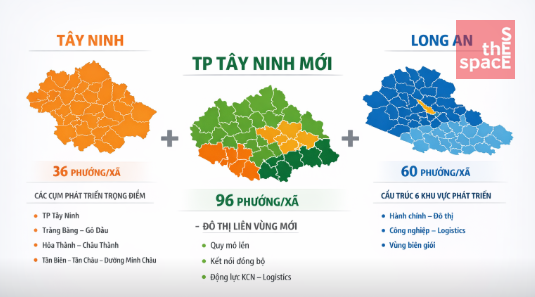
Tây Ninh (36 wards/communes)
Organized into 4 key development zones:
- Central administrative–urban core
- Southern industrial–logistics growth pole
- Urban–industrial expansion belt
- Border logistics, agri-tech, and energy zone
Long An (60 wards/communes)
Structured into 6 development corridors, including:
- Eastern industrial–logistics corridor linked to HCMC
- Northern industrial–urban growth axis (Bến Lức – Đức Hòa)
- Western land-rich corridor suitable for new IPs and logistics
- Border economic and cross-border logistics zones
➡️ Combined scale: 96 wards/communes, forming a new interregional industrial–logistics ecosystem.
4. Implications for Industrial & Logistics Tenants
4.1. Legal Address Updates
New ward/commune names will apply to:
- Land lease agreements
- Investment registration certificates
- Tax, customs, and fire safety documentation
Failure to update in time may result in legal and compliance risks.
4.2. Supply Chain Repositioning
The merger enables a seamless industrial–logistics corridor:
- HCMC: management, finance, HQ functions
- Long An: logistics, warehousing, satellite IPs
- Tây Ninh: manufacturing base, border trade, Cambodia linkage
👉 Enterprises gain flexibility to:
- Reduce rental and operating costs
- Scale production efficiently
- Restructure regional supply chains
4.3. Opportunities for New IPs & Warehousing
- Larger, contiguous land parcels
- Easier master planning for:
- New industrial parks
- Logistics hubs
- Regional distribution centers
Conclusion
The new Tây Ninh City, following its integration with Long An, represents more than an administrative adjustment. It marks a structural reconfiguration of the industrial development landscape in Southern Vietnam. With greater scale, clearer regional connectivity, and abundant land resources, Tây Ninh is emerging as a strategic destination for industrial parks and logistics investment along the western growth corridor.
5. What Should Enterprises Do During the Transition?
✔ Review updated ward/commune names of existing IP locations
✔ Standardize legal addresses in contracts and permits
✔ Reassess IP positioning within the regional supply chain
✔ Work with advisors who fully understand the new administrative boundaries
6. How SEE THE SPACE Supports You
SEE THE SPACE maintains up-to-date data on all new wards/communes in Tây Ninh & Long An, supporting enterprises with:
- Accurate administrative verification for industrial parks
- IP selection advisory based on:
- Industry requirements
- Budget constraints
- Logistics & regional connectivity
- Risk mitigation for:
- New leases
- Factory expansion
- Relocation strategies
Right Space. Right Budget.
- 📞 0768 999 647
- Email: leasing@seethespace.vn
SEE THE SPACE partners with enterprises navigating the rapid restructuring of Vietnam’s industrial and logistics markets.